
How Register Booster Fans Help Correct Uneven Room Temperatures
A home may have a properly working heating and cooling system yet still contain one bedroom, office, or upstairs space that never feels comfortable. In many cases, the problem is not the temperature produced by the HVAC equipment but the amount of conditioned air reaching the room. Properly selected register booster fans can increase airflow from a floor or wall register and help address minor room-to-room temperature differences.
Why Do Certain Rooms Receive Less Airflow?
Forced-air HVAC systems move heated or cooled air through a network of ducts before distributing it through registers. Airflow can weaken as it travels farther from the central equipment, especially when a room sits at the end of a long duct run.
The design and condition of the ductwork also affect delivery. Flexible ducts may sag or become compressed, while rigid ducts can have joints that leak air. Numerous bends, undersized ducts, closed dampers, dirty filters, and blocked registers can further reduce the amount of air entering a room.
Heat gain and heat loss also matter. A room with several windows, limited insulation, exterior walls, or strong afternoon sunlight may require more conditioned air than an interior room. Even when airflow is similar, that room may feel noticeably warmer in summer or colder in winter.
What Does a Register Booster Fan Do?
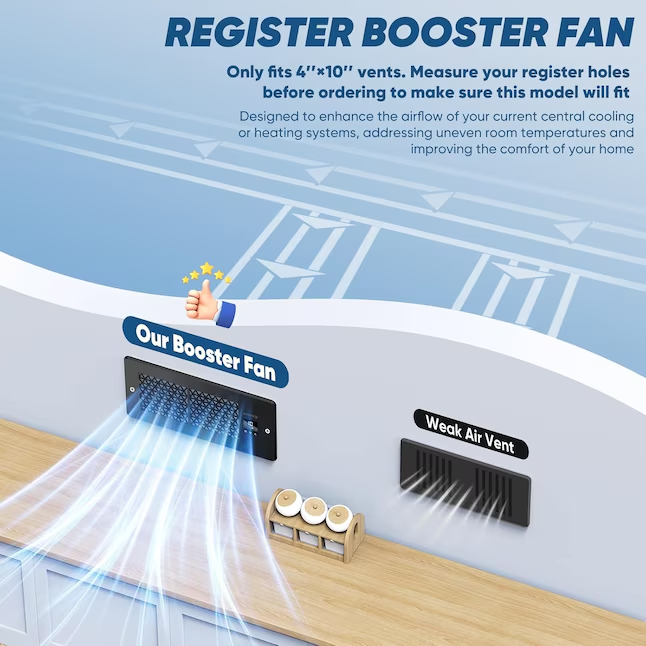
A register booster fan sits in or over an existing supply register. Its fan draws additional heated or cooled air from the duct and pushes it into the room. It does not create warm or cool air independently. Instead, it assists the airflow already supplied by the HVAC system.
Some models use built-in temperature sensors and operate automatically when they detect air from the heating or cooling system. This allows the fan to run during an HVAC cycle without requiring the homeowner to switch it on and off manually.
Register boosters are generally suited to local airflow concerns involving one or a small number of rooms. They are not replacements for furnace repairs, air conditioner service, duct sealing, or complete system balancing.
When Can a Register Booster Fan Help?
A booster fan may be worth considering when one room regularly receives weaker airflow than nearby rooms. Common examples include an upstairs bedroom, a converted attic, a home office above a garage, or a room located far from the air handler.
These fans can also help where furniture placement makes register access difficult. However, repositioning the furniture should be the first step whenever possible. A bed, sofa, cabinet, rug, or curtain covering a register can restrict airflow and create unnecessary comfort problems.
Contractors and home inspectors may also identify register boosters as a possible room-level measure after confirming that the main HVAC system is operating correctly. The fan can be especially helpful when extensive duct modifications would be difficult, disruptive, or costly.
What Should Be Checked Before Installation?
Before adding a booster, inspect the simpler causes of low airflow. Confirm that the supply register is fully open and is not covered by furniture or flooring. Replace a dirty HVAC filter and inspect accessible duct sections for disconnections, crushing, or visible damage.
It is also helpful to compare airflow at several registers. If airflow is weak throughout the property, the issue is unlikely to be limited to one room. A clogged evaporator coil, blower problem, poorly sized system, heavy duct leakage, or incorrect static pressure may require professional attention.
Return-air pathways should also be considered. Conditioned air cannot enter a closed room freely if there is no suitable route for existing air to leave. An undercut door, transfer grille, or dedicated return may be necessary to support proper circulation.
Choosing Between Floor and Wall Register Models
Register size and location should guide product selection. Floor models must fit the register opening and remain stable under normal household conditions. Wall installations require suitable mounting provisions so the unit stays secure.
Users should measure the register rather than estimating its dimensions. They should also check nearby electrical outlet access, cord placement, operating noise, and cleaning requirements. In homes with children or pets, cords should be positioned where they will not create a tripping or pulling hazard.
A booster should remain accessible for routine dust removal. Keeping the grille and fan area clean supports steady airflow and prevents debris from building up around the blades.
Know When the Problem Requires an HVAC Professional
A register booster can assist with a limited delivery problem, but it cannot correct every comfort complaint. Rooms with severe temperature differences may have missing insulation, leaky windows, disconnected ducts, inadequate return air, or improperly sized equipment.
HVAC contractors can measure supply airflow, static pressure, temperature changes, and system performance to identify the actual cause. Energy auditors may also use thermal imaging or pressure testing to locate air leakage and insulation gaps.
For a room-level airflow concern that does not require major duct alterations, a register booster may offer a practical next step. Visit Suncourts to review available airflow and ventilation products and find an option suited to your floor or wall register installation.