
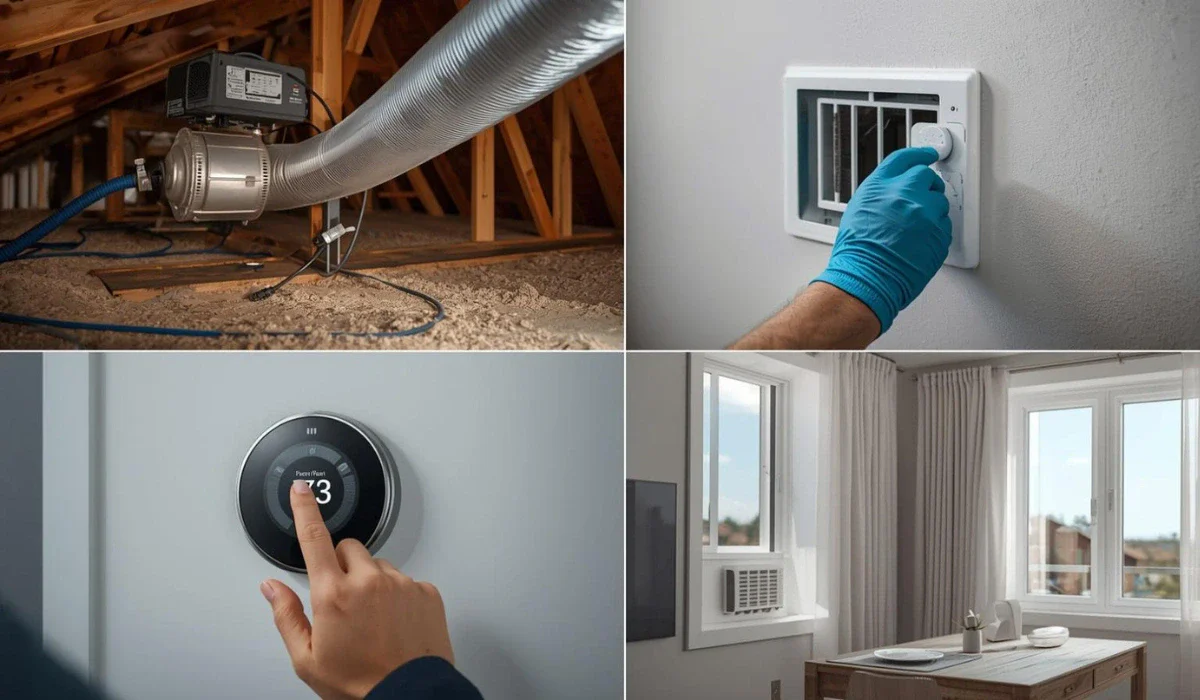
Weak airflow at a distant register is a common issue in homes where certain rooms sit far from the main air handler or furnace. Long duct runs, multiple bends, leakage, and pressure losses can reduce the amount of conditioned air reaching those spaces. When the central HVAC system is operating properly and the duct path is otherwise in good condition, an air duct booster fan can provide additional air movement within the duct and help support better airflow to problem areas.
Start With the Central HVAC System
Before adding any airflow accessory, make sure the main heating and cooling equipment is working as intended.
A clogged filter, dirty blower wheel, restricted coil, incorrect blower setting, or mechanical issue can reduce airflow across the entire duct system. If multiple rooms are experiencing weak airflow, the problem may begin at the air handler rather than within one individual branch.
HVAC contractors should verify blower performance, filter condition, system pressure, and general equipment operation before focusing on one duct run.
For homeowners, basic maintenance such as replacing a dirty filter can sometimes make a noticeable difference.
Inspect the Duct Path
The next step is to inspect the branch serving the room with weak airflow.
Flexible duct can become crushed, kinked, or poorly supported. Sheet metal duct may have loose joints, damaged sections, or internal restrictions. A single problem along the duct path can reduce airflow considerably.
Look for:
- Sagging flexible duct
- Sharp bends
- Loose or disconnected joints
- Damaged duct sections
- Closed balancing dampers
- Blocked registers
- Excessive transitions
Correcting these problems should come before adding a fan.
Consider Duct Length and Resistance
Air loses pressure as it travels through a duct system.
The longer the run, the more resistance the blower must overcome. Elbows, transitions, dampers, grilles, and changes in duct diameter all add additional pressure loss.
A room located near the main trunk may receive strong airflow while another room at the end of a long branch receives much less.
This does not always mean the HVAC equipment is undersized. The issue may simply be that the branch has more resistance than other parts of the system.
Contractors can use airflow and pressure measurements to determine whether the problem is localized.
Check for Air Leakage
Duct leakage can waste a substantial amount of conditioned air before it reaches the intended room.
Loose joints and poorly sealed connections are especially important when ducts run through attics, crawl spaces, garages, or other unconditioned areas.
If air escapes into these spaces, the room at the end of the run may receive only a portion of the expected supply.
Inspect accessible connections and seal leaks using appropriate HVAC materials. Fixing leakage may improve airflow enough that no additional equipment is needed.
Review Duct Sizing
A duct that is too small for the required airflow can create both comfort and noise problems.
Undersized ductwork increases resistance and can limit the volume of air reaching a room. Oversized ductwork can create other airflow concerns depending on system design.
Contractors should compare the duct size with the airflow requirements of the room and the capacity of the system.
A booster fan should not be used as a substitute for correcting serious duct-sizing problems.
Know When a Booster Fan May Help
There are situations where the HVAC system, duct sizing, and duct condition are generally acceptable, but one long branch still delivers less air than desired.
In these cases, an inline fan can assist airflow along that specific duct run.
This can be useful for:
- Rooms located far from the air handler
- Upper-floor spaces
- Home additions
- Converted rooms
- Long branch ducts
- Areas that consistently receive weaker airflow
The fan should be selected based on duct size, expected airflow, available space, and the operating conditions of the system.
Choose the Installation Location Carefully
Placement can affect both fan performance and serviceability.
An inline unit should be installed where it can assist airflow without interfering with other HVAC components. Installers should also consider access for future inspection, cleaning, or replacement.
Attics, basements, crawl spaces, and mechanical rooms are common locations, depending on the home’s layout.
The fan should be installed according to manufacturer instructions, with secure duct connections and proper support.
Poor mounting can create vibration or unnecessary noise.
Consider Controls and Operation
A booster fan does not necessarily need to run continuously.
Depending on the setup, it may operate when the HVAC blower is active or through another suitable control method.
Coordinating operation with the heating and cooling system can help direct added airflow when it is actually needed.
Installers should also consider electrical requirements, control compatibility, and access before beginning installation.
Homeowners should understand how the fan operates and what normal performance sounds like.
Pay Attention to Noise
Any fan installed inside a duct system can create some sound.
Proper sizing and installation can help keep operating noise at an acceptable level. Fan vibration should not be transferred unnecessarily into ductwork or nearby building materials.
Secure mounting, suitable connections, and proper duct support can reduce unwanted vibration.
If the system becomes noticeably louder after installation, inspect the fan location and nearby ductwork rather than assuming the sound is unavoidable.
Test Airflow After Installation
Once the work is complete, verify that airflow has actually improved.
Compare the target register with its previous condition and, where possible, measure airflow rather than relying only on how it feels.
Also check nearby rooms. Increasing airflow through one branch can affect pressure and distribution elsewhere in the system.
A balanced result is more important than simply pushing the maximum amount of air into one room.
If the improvement is limited, additional investigation may be needed to identify hidden restrictions, leakage, or building-related comfort issues.
Improve Airflow by Looking at the Entire Duct System
Weak airflow in a distant room is often caused by a combination of duct length, pressure loss, leakage, restrictions, and system balancing. The right approach is to identify and correct those issues before adding equipment. When a long duct run remains the main source of weak airflow after the system has been checked, an inline booster fan can be a practical addition. HVAC contractors, builders, and homeowners looking for residential airflow products can visit Suncourts to explore options for improving air movement throughout the home.