
The price range on LED bathroom mirrors is wide enough that two products can look nearly identical in a product photo while performing very differently once installed. Some of that gap comes down to marketing dressing up a basic light strip, but a real difference in build quality and light output does exist, and it’s worth knowing what to check before spending more on one model over another.
Light Quality Over Brightness Alone
Lumens get the most attention in product listings, but color accuracy matters more for how a mirror actually performs at the sink. Color Rendering Index, or CRI, measures how accurately a light source reveals true color compared to natural daylight. A mirror rated CRI 90 or above will show skin tones and colors much closer to how they’ll look outdoors, which matters for tasks like applying makeup or checking a shave. Cheaper LED mirrors often skip listing CRI entirely, which is usually a sign the rating isn’t particularly high.
Color temperature is the second variable worth checking. A range spanning roughly 3000K to 6000K covers both a warmer, calmer light for evening use and a cooler, daylight-accurate setting for detailed tasks. Fixed-temperature mirrors, common at the lower end of the price range, lock a household into one setting regardless of time of day or task.
Anti-Fog and Touch Controls
Two features show up often enough on LED mirrors that they’re worth treating as near-standard rather than a premium add-on:
- Anti-fog backing. A heating element behind the glass keeps the surface clear during and after a hot shower, which matters most in bathrooms without strong ventilation.
- Touch-sensor dimming. Rather than a fixed on-off switch, touch controls let brightness adjust gradually, which is more comfortable first thing in the morning than a mirror that switches straight to full brightness.
- Memory settings. Some models retain the last brightness and color temperature setting used, so the mirror doesn’t reset to a default every time it’s turned on.
Frame, Mounting, and Size
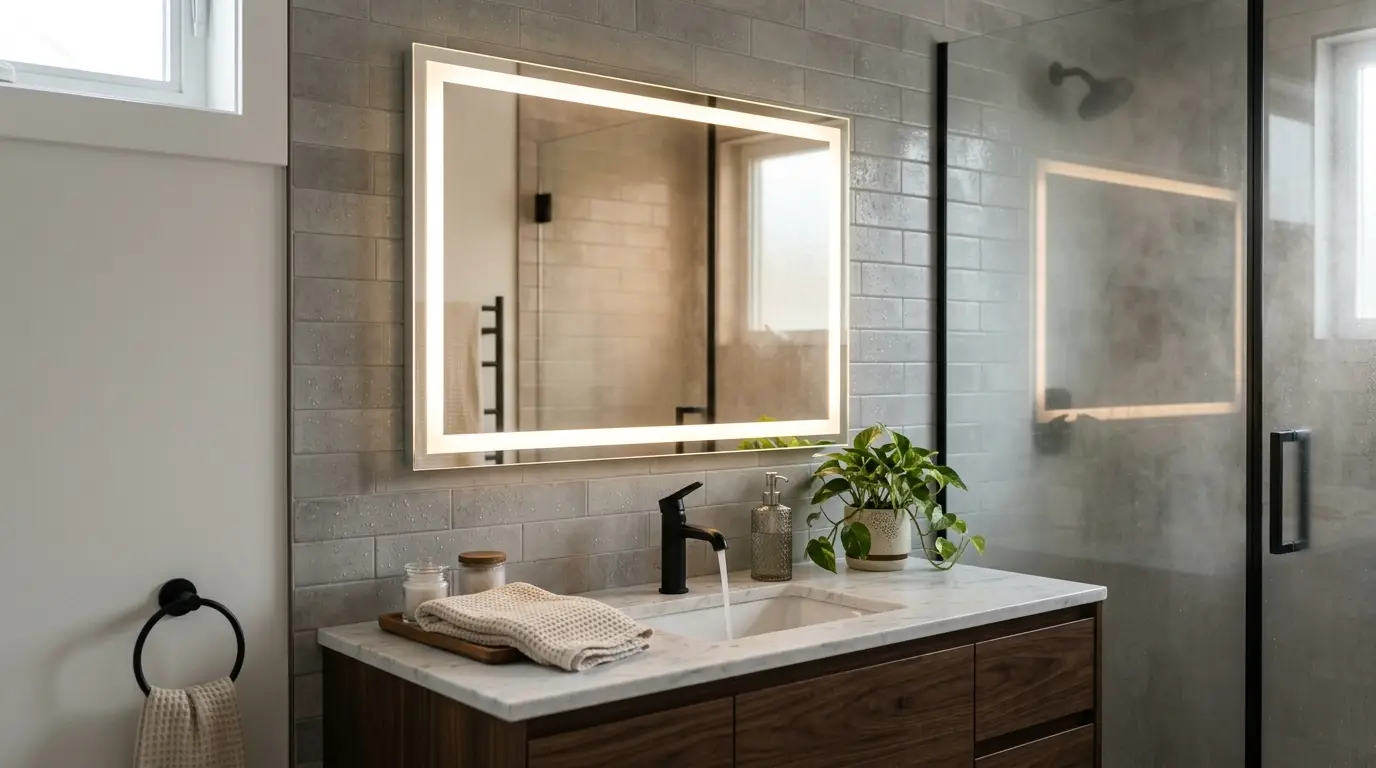
LED mirrors come in backlit designs, where light shines from behind the glass around the perimeter, and front-lit designs, where a strip along the top or sides shines directly onto the face. Backlit designs generally give a softer, more even glow and are less likely to create glare directly in the eyeline, while front-lit designs tend to produce brighter, more directional light suited to closer detail work.
Mounting hardware matters more than it seems on a heavier mirror. Look for a mounting bracket rated for the mirror’s actual weight rather than a generic bracket, since an underrated bracket is the most common reason a wall-mounted mirror eventually shifts or comes loose. Some mirrors also offer no-drill mounting options, which avoid putting new holes in tile, though these tend to work best on smaller or lighter models rather than a full vanity-width mirror.
Sizing relative to the vanity below is worth measuring before ordering. A mirror noticeably narrower than the sink area looks off-balance once installed, and one that’s too wide can crowd sconces or a window frame nearby.
The Takeaway
Not every feature marketed on an LED bathroom mirror translates into a meaningful difference in daily use, but color accuracy, adjustable temperature, and solid mounting hardware consistently do. Shoppers comparing options across retailers, including Allsumhome, will generally get more value focusing on those specifics rather than on frame styling or lumen count alone, since a bright mirror with poor color rendering is still a mirror that makes it harder to tell how something actually looks.